A furnace generates heat by burning fuel; a heat pump moves thermal energy between indoors and outdoors. Choosing between them means balancing Sussex County’s deep winters against the efficiency and savings of modern electric systems. This guide covers the mechanical differences, cold-weather performance, dual-fuel options, installation costs, and the NJ incentives that lower your out-of-pocket price.
How a Heat Pump Differs from a Gas Furnace
A heat pump transfers existing warmth from the outdoor air into your home (and reverses in summer), while a gas or oil furnace creates heat by burning fuel. Because heat pumps move heat rather than create it, they run with exceptional efficiency. In higher-elevation towns like Sparta, Vernon, and Newton, winters run longer and colder than southern NJ — so many homeowners pair a cold-climate heat pump with a furnace as a dual-fuel setup for sub-zero nights.
Do I Need to Replace My AC if I Install a Heat Pump?
No, but it’s recommended. A heat pump both heats and cools, making a separate central AC redundant; running an old AC alongside a new heat pump causes mismatched performance and shorter equipment life. A heat pump replaces your outdoor AC, uses your existing ductwork and air handler, and delivers cooling in July and heat in January. We also offer Hearth financing to fit a full system replacement into your budget.
Ductless Mini-Splits vs. Central Heat Pumps for Older Homes
Many older homes in Hackettstown, Hopatcong, Andover, and Sussex predate central ductwork. Ductless mini-splits are ideal where there are no ducts — no demolition, zoned room-by-room control, and no 20–30% duct losses (downside: visible indoor heads, higher upfront cost for many zones). Central heat pumps suit homes with existing ducts — unobtrusive registers and whole-house filtration (downside: retrofitting ducts into a historic home adds thousands, and a single thermostat can leave upstairs warmer). For 25+ years, Jim Reilly and our family team (NJ #19HC00108700) have helped Sussex County neighbors choose — real licensed technicians, 24/7 at (973) 948-0680, office at 98 Morris Turnpike, Newton.
Heating Efficiency in NJ Winters
Three metrics matter: COP (heat output ÷ electrical input — a COP of 3.0 means 3 units of heat per unit of electricity), AFUE (percent of fuel a furnace converts to heat), and HSPF (a heat pump’s seasonal heating efficiency).
| System Type | Heating Source | COP at 47°F | COP at 5°F | Efficiency |
|---|---|---|---|---|
| Standard Heat Pump | Electricity | 3.5–4.2 | 1.0–1.5 | 8.2–9.0 HSPF |
| Cold-Climate Heat Pump | Electricity | 4.0–4.5 | 1.8–2.5 | 9.0–11.0 HSPF |
| High-Efficiency Gas Furnace | Gas / Propane | — | — | 95%–98% AFUE |
| Standard Gas Furnace | Natural Gas | — | — | 80% AFUE |
| Geothermal Heat Pump | Ground-source | 4.0–5.0 | 3.5–4.5 | 350%–500% |
The 20-Degree Rule
Standard air-source heat pumps rapidly lose capacity and efficiency below 20°F — the outdoor air just doesn’t hold enough extractable heat — forcing them onto inefficient auxiliary electric resistance strips that spike bills. In Northern NJ’s single-digit cold snaps, a standalone standard heat pump leads to high bills and uneven heat.
Standard vs. Cold-Climate Heat Pumps
A standard heat pump excels in mild fall/spring but fades as winter sets in. Cold-climate heat pumps use variable-speed inverter compressors and advanced refrigerant management to hold efficiency below freezing — where a standard unit’s COP drops near 1.0 at 5°F, a cold-climate system holds 2.0+, delivering twice the heat per unit of electricity. A geothermal heat pump goes further, drawing from the stable ~50°F underground. Systems like Mitsubishi Hyper-Heat® (100% capacity at 5°F, operating to -13°F) and the Daikin FIT are built for our deep winters.
Backup Heat & Hybrid Dual-Fuel Systems
Standard heat pumps need a backup heat source once temperatures fall below ~30–40°F — without a fuel-burning backup they fall onto expensive electric heat strips. That’s why a dual-fuel (hybrid) system — an electric heat pump paired with a gas or oil furnace — is highly recommended here. An intelligent thermostat runs the efficient heat pump on mild days (above ~35–40°F) and automatically switches to the furnace below the “switchover” point for fast, high-temperature heat.
Hybrids win on economics (use the cheapest fuel for each temperature) and comfort (a heat pump delivers ~90–100°F air, a furnace ~120–140°F — the intense heat that feels genuinely cozy in a freeze). We tailor configurations: pairing an efficient heat pump with an existing Newton/Andover furnace to create a modern hybrid with minimal disruption, or high-capacity heat pumps with robust gas/propane furnaces for higher Sparta Mountain and Vernon elevations. We calculate the precise “balance point” for your home (NJ #19HC00108700) and offer Hearth financing.
Costs & New Jersey Incentives
A standard gas furnace replacement typically runs 4,500–9,500; an air-source heat pump runs 7,000–16,000+ (it does double duty as heating and cooling, and our climate calls for premium cold-climate/variable-capacity equipment). Incentives close the gap:
- Federal 25C tax credit — 30% of project cost, up to $2,000/year, for eligible high-efficiency heat pumps. See the IRS Energy Efficient Home Improvement Credit.
- State & utility rebates — through the NJ Clean Energy Program and JCP&L, ranging from several hundred to over a thousand dollars based on SEER2/HSPF2 ratings, plus financing options.
Is It Worth Replacing a Working Gas Furnace?
If you have a relatively new, working natural-gas furnace, replacing it purely for savings rarely pays back quickly — natural gas remains cost-effective here. Upgrading makes sense when: your central AC is failing (replace it with a heat pump to create a dual-fuel system); your furnace is over 15 years old; or you heat with oil or propane (switching to an efficient heat pump yields immediate savings).
Operating Costs Under Local Rates
Estimated seasonal operating cost for a typical 2,500 sq ft Sussex County home:
| System Type | Fuel/Source | Est. Seasonal Cost | Notes |
|---|---|---|---|
| Standard Gas Furnace (80–96% AFUE) | Natural Gas (Elizabethtown) | 1,100–1,450 | Reliable high heat, independent of outdoor temps. |
| Standard Heat Pump (14–16 SEER2) | Electricity (JCP&L) | 1,900–2,600 | Struggles in deep freezes; leans on costly aux strips. |
| Cold-Climate Heat Pump | Electricity (JCP&L) | 1,200–1,550 | Extracts heat to -15°F without raw electric backup. |
| Dual-Fuel Hybrid | Electricity + Gas | 1,000–1,350 | Auto-switches to the cheapest fuel for each temperature. |
Estimates assume professional installation, proper ductwork, and average insulation.
Local rates: JCP&L electricity runs roughly 0.18–0.21/kWh; Elizabethtown Gas roughly 1.10–1.40/therm. Because electricity is relatively expensive here, a heat pump needs a COP of about 3.0 to match natural gas — which is exactly why a dual-fuel configuration is often the most cost-effective choice for local homes.
Why Is My Heat-Pump Bill So High?
Common causes: continuous auxiliary heat-strip use in the cold; deep thermostat setbacks (which force the heat pump into energy-draining recovery mode — unlike a furnace); poor insulation/leaky ducts in older homes (heat pumps supply lower-temperature air, so drafty rooms run the system nonstop); and improper sizing or low refrigerant. We diagnose efficiency issues and optimize your system for Sussex County winters — 24/7 at (973) 948-0680.
Maintenance & Lifespan
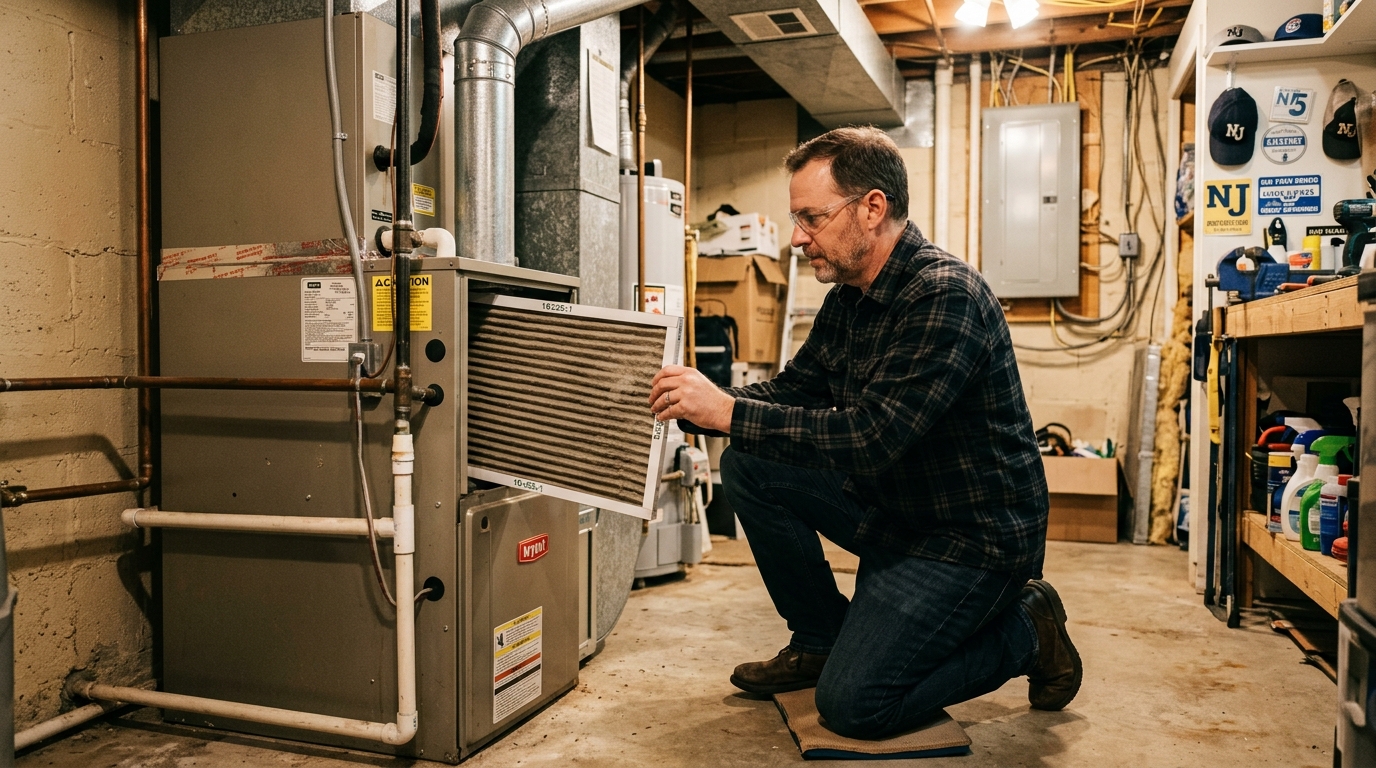
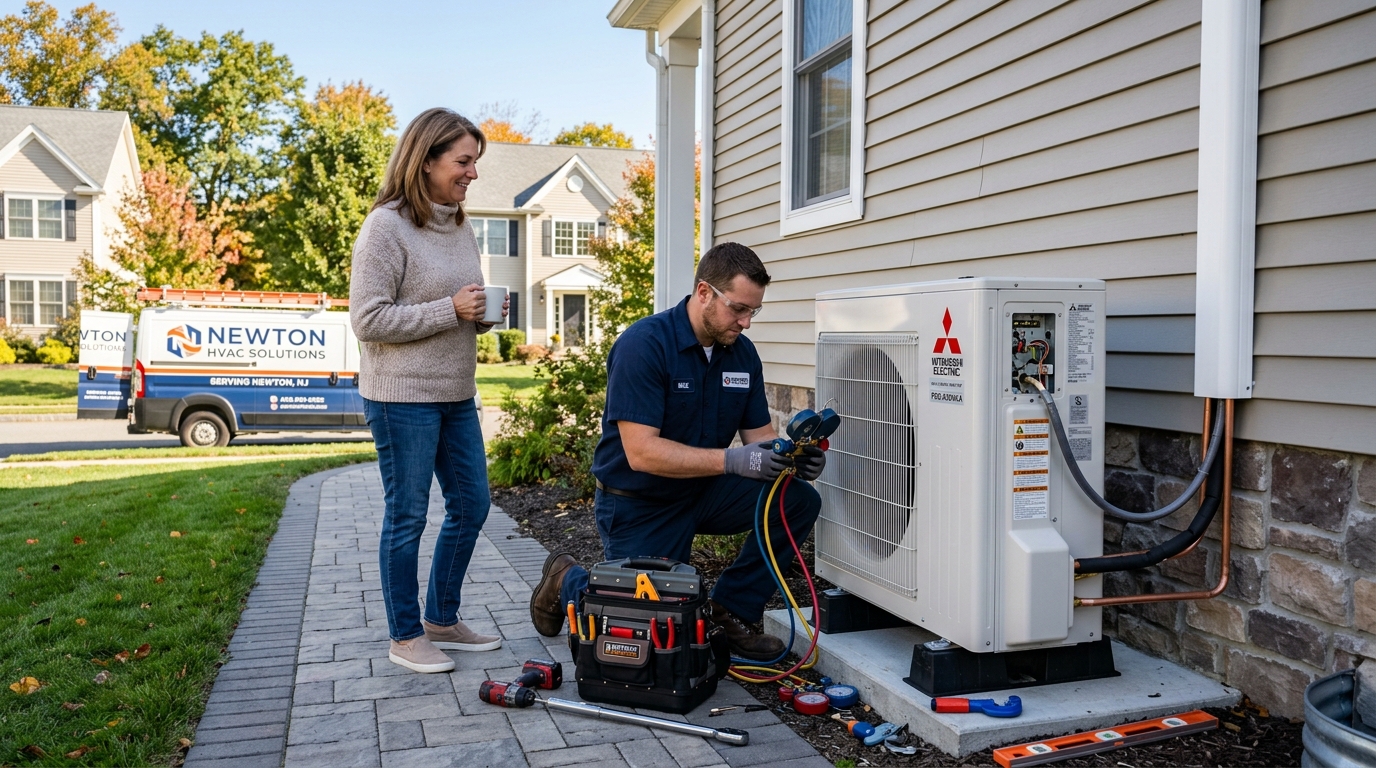
Because a heat pump runs year-round (heating and cooling), it needs twice-a-year service (spring + fall) and typically lasts 10–15 years. A gas furnace sits idle all summer, so a single annual fall tune-up suffices and it typically lasts 15–20 years. Before winter: clear 18–24 inches around the outdoor unit and keep snow off it; confirm the condensate drain is clear and sloped; elevate the heat pump 4–8 inches on snow feet; replace filters every ~90 days; and book a professional pre-winter inspection.
FAQs
Is a permit required to switch from a gas furnace to a heat pump in Sussex County?
Yes. The switch involves electrical work (a new 240-volt line) and altering or decommissioning gas lines, so electrical, plumbing, and building permits are typically required. A licensed HVAC pro handles the permitting to ensure compliance with the NJ Uniform Construction Code.
Can I use a Nest or Ecobee with a dual-fuel system?
Yes, but it must be configured for hybrid heating so it manages the crossover temperature where the system switches from heat pump to furnace. Some simpler models lack the wiring terminals or control logic for two heat sources — professional configuration ensures seamless switching without defaulting to expensive electric strip heat.
How does snow and ice on the outdoor unit affect performance?
Accumulation blocks the coil’s airflow and forces frequent defrost cycles. Minor frost is normal and handled automatically, but heavy snow blocking the intake cuts heating capacity. Elevating the unit on a snow stand and keeping drifts clear preserves performance through NJ storms.
How long does it take to replace a furnace with a complete heat pump system?
Typically one to two days. Running new electrical lines, modifying ductwork, or installing a dual-fuel configuration can extend it into a second day.
Get Your Free Heating System Estimate Today
Deciding between a cold-climate heat pump, a high-efficiency furnace, or a hybrid dual-fuel system? Jim Reilly and the licensed experts at Constant Air Service are ready to help. Family-owned since 1999, available 24/7 at (973) 948-0680, with transparent assessments, professional heating and furnace installation (NJ #19HC00108700), and flexible financing for Newton and all of northern New Jersey.
Constant Air Service handles this for homeowners across Newton and Sussex County — licensed, family-owned since 1999, and available 24/7. Explore the related services:
Call (973) 948-0680