Geothermal heating and cooling systems represent one of the most energy-efficient investments Sussex County homeowners can make, leveraging New Jersey’s stable underground temperatures to provide year-round comfort at a fraction of traditional HVAC operating costs. However, the upfront installation expense often gives homeowners pause—especially when navigating conflicting online estimates and complex incentive programs. This comprehensive 2026 pricing guide breaks down exactly what Sussex County residents in Newton, Sparta, Vernon, and surrounding communities can expect to pay for geothermal installation, including equipment, labor, ground loop systems, and how to maximize New Jersey’s substantial rebates and tax credits.
What is the average geothermal installation cost in Sussex County?
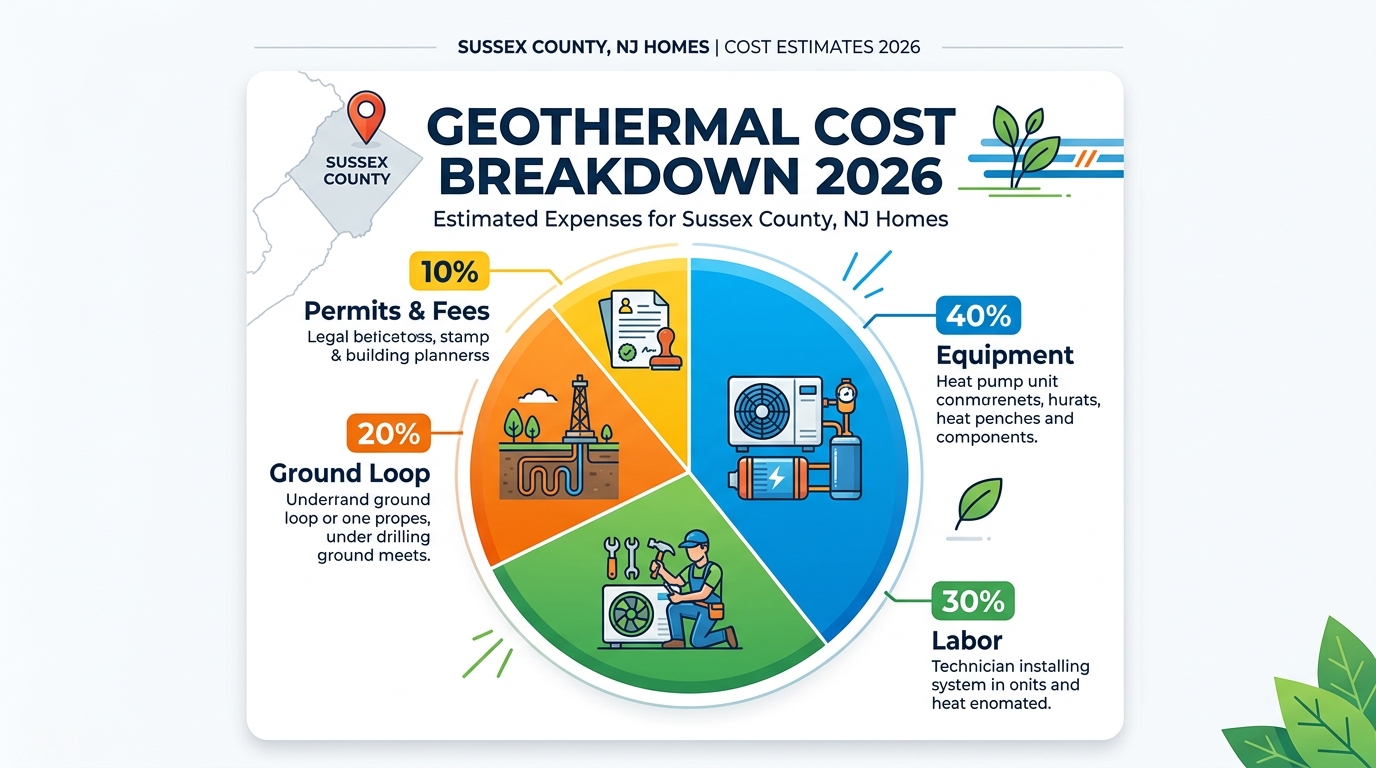
For a typical 2,500-square-foot Sussex County home, complete geothermal installation ranges from $20,000 to $45,000, with most systems averaging $32,500 for a 5-ton closed-loop configuration. This wide variance reflects site-specific factors like soil composition, property size, existing ductwork, and the choice between horizontal versus vertical ground loops. Horizontal loops (requiring ½–¾ acre of accessible land) typically cost $15,000–$30,000, while vertical loops (drilled 150–400 feet deep) run $20,000–$45,000 due to specialized drilling equipment and labor.
The installed cost per ton—the standard industry measurement—falls between $4,000 and $9,000 in Sussex County, with most homeowners paying approximately $6,500 per ton. A 4-ton system suitable for a well-insulated 2,000-square-foot home would therefore cost $26,000 before incentives, while a 6-ton system for a 3,500-square-foot residence might reach $39,000. These figures include the heat pump unit, ground loop installation, labor, electrical connections, permits, and basic ductwork modifications.
What geothermal rebates and incentives are available in New Jersey?
HVAC Services in Newton, NJ | Heating & Cooling Experts
New Jersey offers some of the nation’s most generous geothermal incentives, which can reduce your net installation cost by 30–50%. The 2026 NJ Clean Energy Program provides rebates up to $5,000 for ground-source heat pumps, while the federal Residential Clean Energy Tax Credit covers 30% of installation costs with no upper limit. Combined, these programs can save Sussex County homeowners $10,000–$20,000 on a typical geothermal installation.
NJ Clean Energy Program Rebate: Administered by the New Jersey Board of Public Utilities, this incentive offers $1,000 per ton up to $5,000 for qualifying geothermal installations. The rebate applies to both new construction and retrofit projects, requires participation by a NJ-certified contractor like Constant Air Service, and must be pre-approved before installation begins.
Federal Tax Credit (26 U.S.C. § 25D): The Inflation Reduction Act extended the 30% geothermal tax credit through 2034, with no maximum dollar limit. This credit applies to both equipment and installation labor, and can be carried forward to future tax years if it exceeds your current tax liability. For a $32,500 installation, this creates a $9,750 tax credit.
NJ Sales Tax Exemption: Geothermal equipment purchases are exempt from New Jersey’s 6.625% sales tax, saving approximately $1,500–$2,000 on equipment costs.
Utility Company Incentives: Sussex County residents served by Jersey Central Power & Light (JCP&L) or Orange & Rockland may qualify for additional rebates up to $2,000 through their energy efficiency programs.

How long does geothermal installation take in Sussex County?
From initial site assessment to system commissioning, geothermal installation typically requires 3–6 weeks in Sussex County, depending on loop type, weather conditions, and permit approval timelines. The process follows six distinct phases, each with its own timeline considerations specific to New Jersey’s climate and regulatory environment.
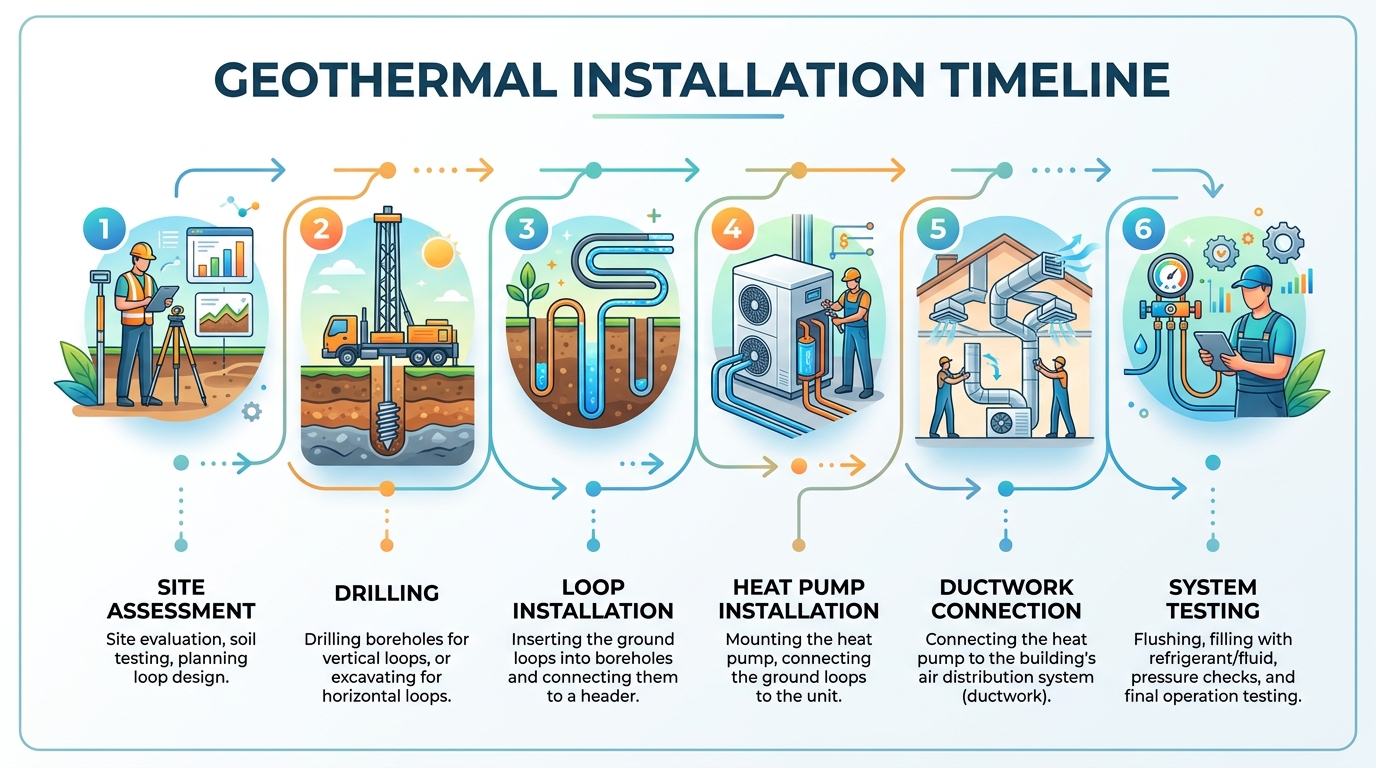
Week 1: Site Assessment & Design (3–5 days) – A certified geothermal technician evaluates your property’s soil conditions, available space, existing HVAC infrastructure, and heating/cooling load requirements. This phase includes Manual J heat loss calculations specific to Sussex County’s climate zone (4A) and submission for NJ Clean Energy Program pre-approval.
Week 2: Permitting & Utility Coordination (5–10 days) – Local building permits (required in all Sussex County municipalities) and electrical permits are secured. Drilling permits may require additional environmental review in protected watershed areas. Parallel coordination with JCP&L ensures adequate electrical service for the heat pump’s 240-volt requirement.
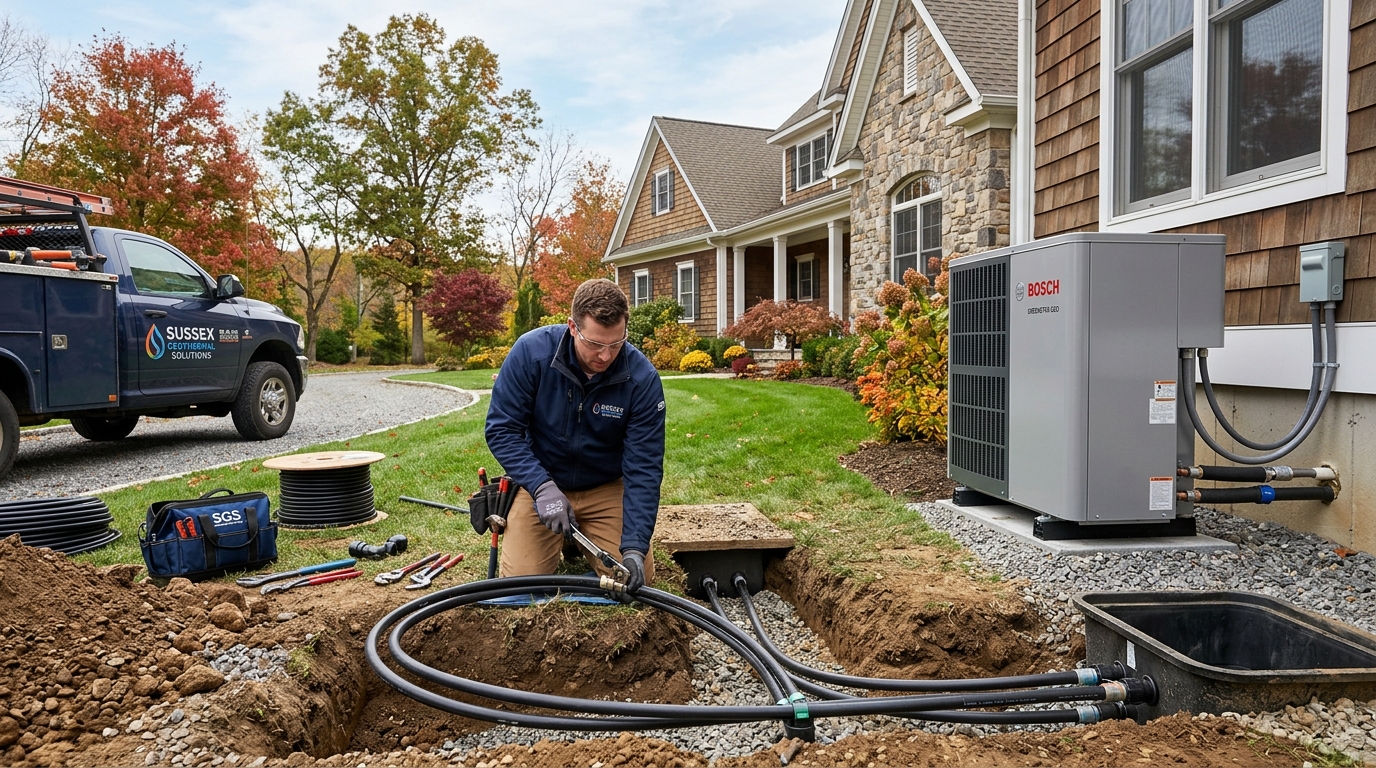
Weeks 3–4: Ground Loop Installation (10–15 days) – Horizontal loops require trenching equipment and typically take 7–10 days for a standard residential property. Vertical loops involve drilling rigs and take 10–15 days, with additional time needed for well sealing and pressure testing to meet NJ Department of Environmental Protection standards.
Week 5: Heat Pump & Ductwork Installation (3–5 days) – The indoor heat pump unit is installed in your basement or utility room, connected to existing ductwork or new mini-duct systems. Electrical connections are completed by a licensed New Jersey electrician.
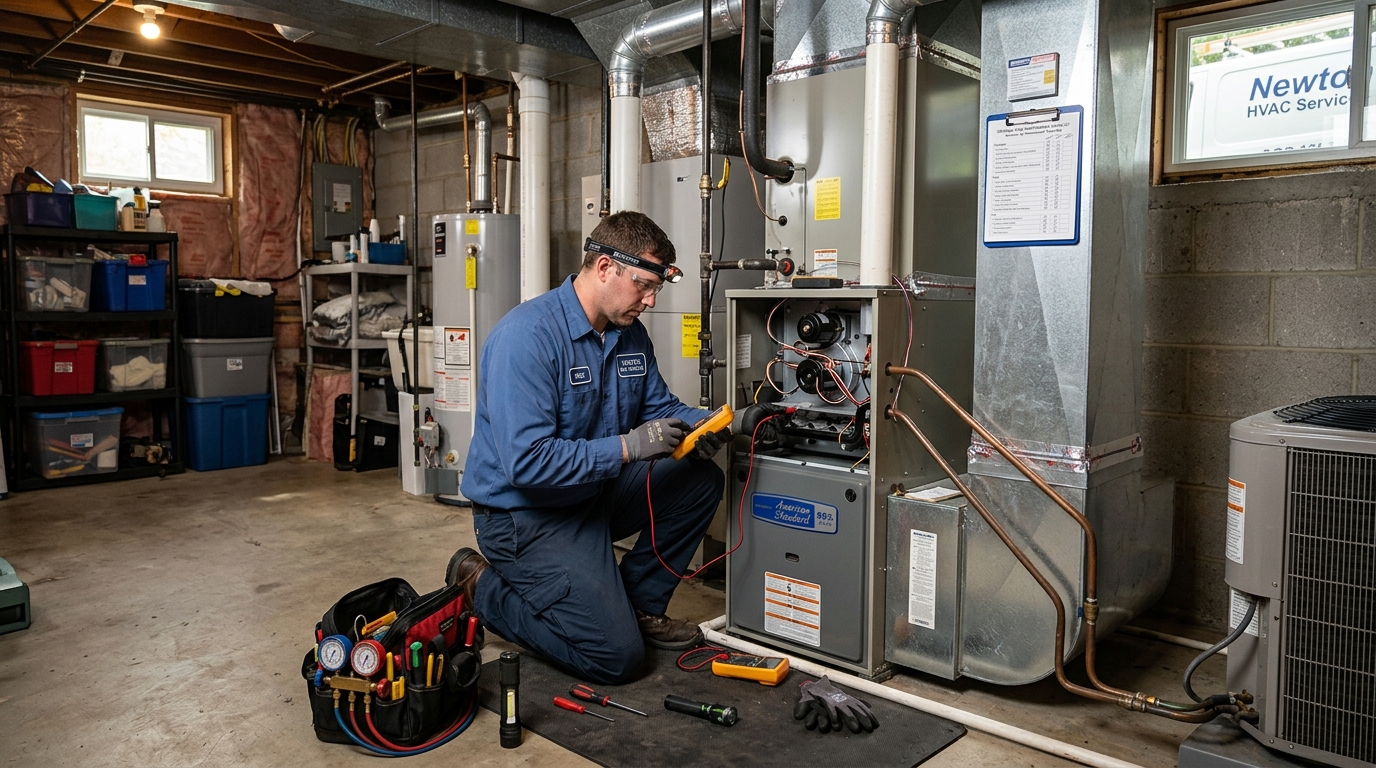
Week 6: System Commissioning & Testing (2–3 days) – Final pressure testing, refrigerant charging, thermostat programming, and performance verification ensure the system meets manufacturer specifications and qualifies for warranty coverage.
What factors affect geothermal installation costs in NJ?
Six primary variables determine your final geothermal installation expense in Sussex County:
- Property Size & Soil Conditions – Clay-heavy soils common in Newton and Sparta require more drilling time than sandy soils found in Vernon Township. Rocky terrain can increase drilling costs by 20–30%.
- Loop Configuration Choice – Horizontal loops cost 25–40% less than vertical loops but require substantial usable land. Vertical loops minimize surface disturbance but demand specialized drilling equipment.
- Existing Ductwork Condition – Homes with modern, properly sized ductwork need minimal modifications ($1,000–$3,000). Older Sussex County homes (pre-1980) often require duct sealing, replacement, or mini-split alternatives ($4,000–$8,000).
- Heat Pump Efficiency Rating – Units with higher COP (Coefficient of Performance) ratings (COP 4.0–5.0) cost 15–25% more upfront but deliver greater long-term energy savings.
- Electrical Service Upgrade – Many older Sussex County homes require electrical panel upgrades ($1,500–$3,500) to support geothermal’s 240-volt, 40–60 amp circuit.
- Local Permit Fees – Municipal permit costs vary significantly across Sussex County, from $500 in Andover Township to $1,200 in Sparta Township.
How does geothermal compare to traditional HVAC installation costs?
While geothermal installation costs 2–3 times more than a high-efficiency furnace and air conditioner combination ($12,000–$18,000), the lifetime cost analysis reveals a different story. Over a 25-year period—the typical geothermal system lifespan—Sussex County homeowners save $35,000–$50,000 in energy costs, resulting in a net savings of $15,000–$30,000 compared to conventional HVAC.
Annual Operating Cost Comparison (2,500 sq ft home):
- Geothermal System: $600–$900/year (electricity only)
- High-Efficiency Gas Furnace + AC: $1,800–$2,400/year (gas + electricity)
- Oil Furnace + AC: $2,200–$3,000/year (oil + electricity)
This $1,200–$2,100 annual savings, combined with geothermal’s superior dehumidification in Sussex County’s humid summers and consistent comfort during harsh winters, explains why 22% of new custom homes in the county now include geothermal systems despite the higher initial investment.
Frequently Asked Questions About Geothermal Installation Costs
How much does a 5-ton geothermal system cost in NJ?
A 5-ton geothermal system—suitable for most 2,500–3,000 square foot Sussex County homes—costs $28,000–$38,000 installed, before incentives. After applying NJ rebates ($5,000) and the federal tax credit (30%), the net cost drops to $16,100–$23,100.
Can I install geothermal on a small lot in Sussex County?
Yes—vertical loop systems require only a 10×10 foot drilling area, making them ideal for Newton’s historic districts and Sparta’s wooded properties where horizontal space is limited. “Slinky” horizontal loop configurations can also reduce land requirements by 30–40% compared to traditional horizontal layouts.
Do geothermal systems work during NJ power outages?
Like all electric HVAC systems, geothermal requires power to operate. However, their lower electrical demand (compared to air-source heat pumps) makes them ideal candidates for whole-house backup generators. A 10–12 kW generator can typically power a geothermal system during Sussex County’s occasional winter outages.
How long do geothermal systems last in NJ’s climate?
Geothermal systems are exceptionally durable in New Jersey’s climate. The underground loop carries a 50–100 year warranty and typically lasts the life of the home. Indoor heat pump components last 20–25 years—twice as long as conventional HVAC equipment—due to protected indoor installation and reduced operational stress.
Is geothermal installation disruptive to my property?
Modern directional drilling techniques minimize surface disruption. For vertical loops, the drilling rig occupies the driveway or street frontage for 2–3 days, leaving only small well caps visible afterward. Horizontal loop installations restore the landscape within a week, with careful attention to Sussex County’s native plant preservation requirements.
Get Your Personalized Geothermal Installation Quote
Ready to explore geothermal for your Sussex County home? Constant Air Service, Newton’s premier HVAC contractor, provides comprehensive geothermal assessments including Manual J load calculations, incentive program navigation, and detailed financing options. Our NJ-certified technicians have installed over 40 geothermal systems across Sussex County, from historic Newton residences to new construction in Vernon’s luxury communities.
Schedule your free geothermal consultation today and discover how New Jersey’s generous rebates can make this ultra-efficient technology surprisingly affordable. We’ll provide a transparent, itemized quote showing your exact costs, projected energy savings, and return on investment timeline specific to your Sussex County property.