A ductless mini split is a high-efficiency heating and cooling system that connects an outdoor compressor to one or more indoor air-handling units through small conduit lines — removing the need for traditional ductwork. Because these systems allow zone-specific temperature control, they’re increasingly popular for retrofitting older homes and managing comfort in custom layouts.
This guide details average installation pricing, compares ductless technology to traditional HVAC, explains how to size a system, and outlines how layout affects labor costs — plus contractor vetting and the New Jersey incentives that lower your out-of-pocket cost.
Average Cost of Ductless Mini Split Installation
The average ductless mini split cost in Sussex County ranges from 4,000 to 22,000+, depending mostly on the number of zones. A single-zone system runs 4,000–6,500 fully installed; multi-zone configurations range from 7,000 for 2 zones up to 22,000+ for a 4-zone system.
| System Type (Zones) | Equipment Cost | Labor & Material | Total Average |
|---|---|---|---|
| Single-Zone | 2,000–3,500 | 2,000–3,000 | 4,000–6,500 |
| 2-Zone | 4,000–6,000 | 3,000–4,500 | 7,000–10,500 |
| 3-Zone | 6,000–8,500 | 4,500–6,500 | 10,500–15,000 |
| 4-Zone | 8,000–12,000 | 6,000–10,000+ | 14,000–22,000+ |
What’s a Reasonable Price?
A reasonable price covers more than mounting units. At Constant Air Service, turn-key installations include professional electrical disconnects, durable line-set covers (line-hide) for harsh Sparta winters, heavy-duty condenser brackets, and municipal permit processing — backed by a fully licensed contractor (NJ HVACR #19HC00108700). We also offer flexible financing through Hearth. Cheap installs often skip line-set covers or pull permits illegally, leaving you exposed when temperatures drop.
Why Professional Installation Costs What It Does
Safe operation requires deep expertise: federal EPA Section 608 licensing to handle refrigerants, precise high-voltage wiring, high-pressure nitrogen flare-joint tests, and micron vacuum extraction to remove moisture before startup. Legal installation in Newton, Vernon, and nearby towns also requires municipal building and electrical permits plus coordinated inspections to preserve your manufacturer’s warranty.
Ductless vs. Traditional HVAC
Retrofitting central-air ductwork into older multi-story Sussex County homes often means cutting into plaster, lowering ceilings, and sacrificing closet space — typically adding 5,000–10,000 in carpentry. Ductless avoids that and lowers running costs through:
- Zoned control — heat or cool only active rooms, reducing waste.
- No duct losses — traditional ducts can lose up to 30% of thermal energy; ductless bypasses this.
- Variable-speed inverters — instead of running at 100% or 0%, the compressor modulates speed for far lower bills.
- Seasonal flexibility — handles humid summers and sub-zero winters.
Compared with heating oil, propane, or electric baseboards, a modern mini-split usually cuts winter bills and runs quieter. And maintenance is user-friendly: wash the reusable mesh filters every few weeks to keep airflow high.
Sizing, BTU Calculations & Efficiency
Sizing for Square Footage
Each indoor unit is sized to its room using BTUs (British Thermal Units) — the measure of heating/cooling supplied per hour.
| Square Footage | Recommended BTU | Typical Configuration | Example |
|---|---|---|---|
| 100–250 | 6,000 BTU | Single-zone wall mount | Spare bedroom or office |
| 250–400 | 9,000 BTU | Single-zone wall/floor | Standard bedroom or study |
| 400–600 | 12,000 BTU | Single/dual-zone | Master suite or cottage living room |
| 600–900 | 18,000 BTU | Single/multi-zone | Open-concept kitchen + family room |
| 1,000–1,500 | 24,000+ BTU | Multi-zone (2–3 heads) | Full basement or first floor |
Calculating BTUs
Base formula: Room Area (Length × Width) × 25 = Base BTU Requirement. For example, a 20 × 16 ft room = 320 sq ft × 25 = 8,000 BTU. Then adjust: +10% for ceilings over 8 ft; −10% if heavily shaded/north-facing or +10% for strong south-facing sun; +4,000 BTU for kitchens; +600 BTU per occupant over two; and +15–20% for older, draftier, uninsulated homes common in Fredon Township or Green Township.
Why Bigger Isn’t Better
An oversized unit short-cycles — blasting the room, hitting the setpoint, and shutting off before it can dehumidify or circulate air evenly. The result: clammy high humidity, hot and cold spots, and accelerated wear (the compressor takes the most strain on startup), cutting equipment lifespan in half.
SEER2, HSPF2 & Inverter Technology
SEER2 measures cooling efficiency over a season; HSPF2 measures heating efficiency — critical in colder, higher-elevation Sparta and Vernon. The secret behind high ratings is inverter technology: rather than cycling on/off at 100%, the compressor modulates like a dimmer (10%, 45%, 90%) to hold a steady temperature on a fraction of the electricity.
Why Bills Can Spike After Installation — and How to Avoid It
Mini-splits are built for a “set and forget” strategy. They run continuously at low, efficient speeds, so if you turn the system off while away and back on later, the inverter ramps to 100% to re-condition the warm furniture, floors, and walls — spiking your bill. Pick a temperature, leave it on, and let the inverter work. Also, undersized systems (or turning the thermostat up more than 2°F at once) engage inefficient auxiliary electric heat strips that use up to four times more power. Proper sizing for our local climate prevents that — learn about our family-owned team.
Layout Complexity & Labor
Home age, insulation, and design drive labor hours in Sussex County:
- Historic masonry/stone walls require slow, precise diamond-core drilling for refrigerant lines.
- Lath, plaster, and timber framing in older lake homes crack easily, demanding careful mounting.
- Uninsulated attics/crawlspaces need heavy-duty line-set insulation to prevent thermal loss and condensation.
- Multi-story line runs require vertical routing, scaffolding, and exterior covers.
Do You Need a Unit in Every Room?
No — design open-concept thermal zones instead. Placing high-capacity heads in main living areas lets conditioned air flow into adjacent spaces, which minimizes equipment counts, reduces wall penetrations and copper runs, and prevents short-cycling.
Unit Mounting Types & Cost
- Standard high-wall units — most common and cost-effective; minimal structural work.
- Floor-mounted consoles — ideal for low ceilings or limited wall space; ~10–20% premium.
- Recessed ceiling cassettes — flush, unobtrusive, but labor-intensive (drywall cuts, custom framing, condensate pumps); 30–50% more than wall units.
Typical Timelines
- 1-zone: 4–6 hours (half a day).
- 2-zone: ~1 day (8–10 hours).
- 3-zone: 1.5–2 days.
- 4+ zone: 2–3 days for complex or historic homes.
As a family-owned, fully licensed contractor (#19HC00108700) that answers 24/7 and never uses rotating subcontractors, we complete projects efficiently. Contact Constant Air Service for a site assessment and an itemized quote.
Before You Buy
- Electrical capacity: most systems run on dedicated 208/230-volt circuits; older 100-amp panels in historic Newton/Sparta homes may need an upgrade or subpanel.
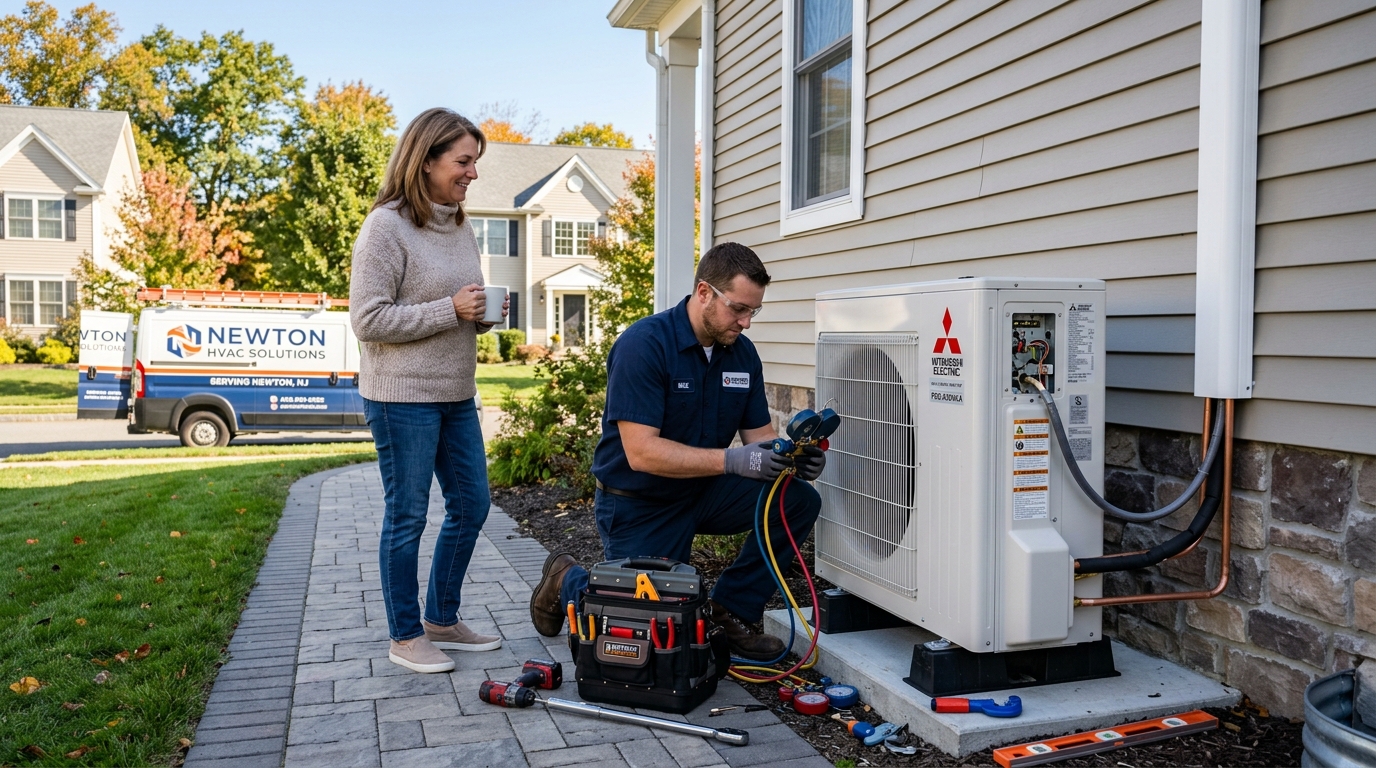
- Exterior clearance: plan 12–24 inches behind/beside the condenser, and mount it on a bracket or raised stand to clear snow.
- Drainage: indoor heads need ~6 inches of ceiling clearance and a sloped gravity drain or a condensate pump.
Questions to Ask Any Contractor
- “Can you provide your active NJ HVACR license number?” (Ours is #19HC00108700.)
- “Are your technicians EPA Section 608 certified?” (Federally required to handle refrigerant.)
- “Do you have factory-specific training for the brands you install?” (Mitsubishi, Daikin, etc. have specific requirements.)
- “Will you handle the municipal permits and inspection for our township?”
- “What workmanship warranty do you offer beyond the manufacturer’s parts warranty?”
DIY Kits vs. Professional Installation
DIY kits carry real risks. Major manufacturers (Mitsubishi, Daikin, Fujitsu) void the 10–12-year parts warranty if the system isn’t installed by a licensed pro. DIY “quick-connect” line sets are prone to slow refrigerant leaks that wreck efficiency and bills. And installation involves 240V electricity plus specialized vacuum/micron tools to dehydrate the lines — moisture left inside forms acid that destroys the compressor from within. Professional installation guarantees correct sizing, manufacturer-spec install, and full warranty coverage.
Sussex County Climate & NJ Incentives
Our higher-elevation winters are among the most demanding in New Jersey. Standard heat pumps lose capacity below 32°F and fall back on inefficient electric heat strips. Cold-climate “hyper-heat” mini-splits use flash-injection compressors that maintain 100% heating capacity at 5°F and keep running down to -13°F — a necessity here, not an upgrade.
Incentives offset the higher upfront cost:
- Federal 25C tax credit — up to $2,000 (30% of install cost) for qualifying ENERGY STAR heat pumps.
- State & utility rebates through the New Jersey Clean Energy Program — including JCP&L rebates for systems replacing electric baseboard or old heat pumps, and Elizabethtown Gas pathways for high-efficiency upgrades.
We help you select eligible equipment, gather documentation, and maximize savings — plus Hearth financing to make the transition affordable.
Sussex County Ductless FAQs
Can a ductless mini split completely replace a whole-house boiler in Sussex County?
Yes — with strategic design. Because our winters drop well below freezing, you must select cold-climate “hyper-heat” units that hold full capacity at negative temperatures, and perform room-by-room load calculations so each head matches your home’s heat loss. The payoff is zoned control and no bulky radiators.
What electrical upgrades does a multi-zone install require?
Most multi-zone condensers run on a 208/230-volt circuit with a dedicated 20–50-amp breaker. Homes still on a 100-amp panel may need a 200-amp service upgrade. A licensed pro runs a dedicated line to an outdoor disconnect near the compressor, which feeds the indoor heads through shielded multi-conductor cabling.
Are line sets easily damaged by winter weather or wildlife?
Copper line sets are resilient but vulnerable to heavy snow, falling icicles, and chewing squirrels or mice. Professional installers enclose them in heavy-duty PVC or metal “slim duct” covers that shield against weather and UV and deter nesting — preserving efficiency.
How often should a mini split be professionally serviced?
Twice a year. Because heat pumps run nearly year-round, they see double the wear of single-season systems. A spring visit preps cooling and a fall visit preps heating; technicians deep-clean coils, clear condensate drains, check refrigerant, and inspect electrical connections.
Get Your Personalized Installation Quote Today
To keep your home comfortable through freezing winters and humid summers, evaluate your ductless installation options with local experts. Call Constant Air Service at (973) 948-0680 or visit our Newton office for a precise, transparent quote tailored to your Sussex County home.
Constant Air Service handles this for homeowners across Newton and Sussex County — licensed, family-owned since 1999, and available 24/7. Explore the related services:
Call (973) 948-0680