How Geothermal HVAC Systems Provide Year-Round Comfort and Save You Money
A geothermal HVAC system extracts heat from the ground in winter and dumps indoor heat back into the ground in summer, using the earth’s stable 55°F temperature to deliver 300–500% efficiency and cut household energy bills by 30–70% year-round. For hvac-repair/” title=”Newton”>newton-new-jersey-hvac-repair/” title=”Sussex County”>Sussex County homeowners facing frigid Newton winters and humid summer peaks, that translates to steady indoor comfort without the fuel deliveries, noisy outdoor condensers, or volatile energy costs that come with conventional furnaces and air conditioners.
Constant Air Service has installed and serviced geothermal systems across northwest New Jersey since 1999. We have seen firsthand how this technology performs in Sussex County‘s higher-elevation climate, and the results are hard to ignore: lower utility bills, quieter homes, and heating and cooling that holds steady even when the mercury drops below zero.
How does a geothermal HVAC system actually work?

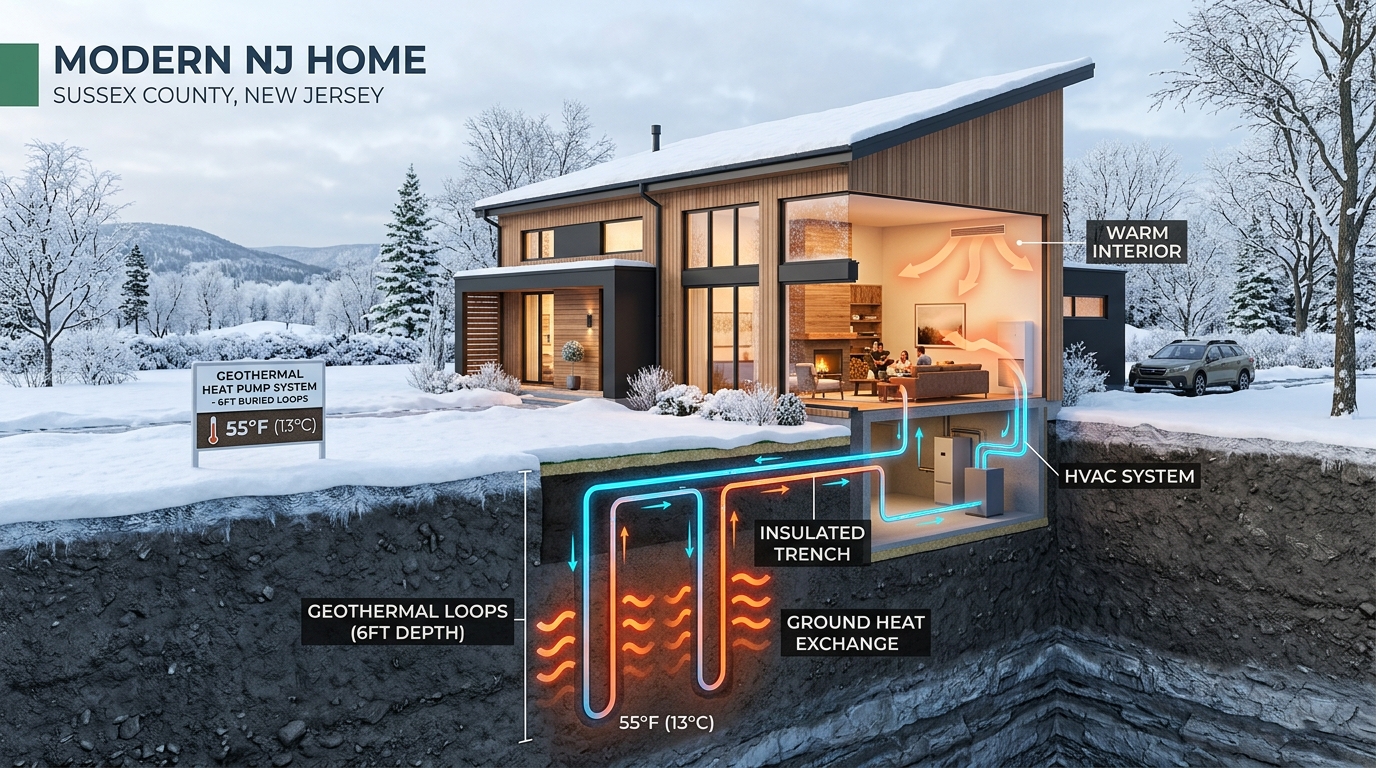
A ground-source heat pump moves heat instead of creating it. In heating mode, an antifreeze solution circulates through a buried loop of polyethylene pipes, absorbing latent warmth from soil that stays between 50°F and 60°F year-round. The heat pump’s compressor concentrates that thermal energy and distributes it through your home’s ductwork or radiant tubing. In cooling mode, the cycle reverses: the system extracts indoor heat and deposits it into the same ground loop, leaving your living space crisp without the high-pressure refrigerant cycles of traditional AC.
Three components make this possible:
- Ground loop: A sealed network of pipes buried horizontally four to six feet deep or vertically in boreholes reaching 150–400 feet. The loop circulates a water-glycol mixture that never mixes with soil or groundwater.
- Heat pump unit: Housed indoors—typically in a basement or utility room—this unit contains the compressor, heat exchanger, and controls. Because it sits inside, it is shielded from ice, snow, and corrosion.
- Distribution system: Existing ductwork, hydronic radiators, or in-floor radiant loops carry conditioned air or water throughout the home.
Unlike a gas furnace that burns fuel to generate heat, or a conventional air-source heat pump that struggles when outdoor air falls below freezing, a geothermal system leverages an underground reservoir whose temperature changes very little regardless of the weather above. The U.S. Department of Energy notes that this stability allows geothermal heat pumps to achieve efficiency ratings of 400% or higher, delivering four units of heat for every unit of electricity consumed (energy.gov).
Are geothermal heat pumps more efficient than furnaces and air conditioners?

Yes—and the gap is substantial. A premium gas furnace reaches an Annual Fuel Utilization Efficiency (AFUE) of 95–98%, meaning nearly all the fuel it burns becomes heat. That sounds impressive until you realize a geothermal heat pump operates at a Coefficient of Performance (COP) between 3.0 and 5.0. In practical terms, that 300–500% efficiency means geothermal moves three to five times more thermal energy than the electricity it draws.
Air-source heat pumps, by comparison, typically hit COPs of 2.0 to 3.0 in mild weather and drop sharply when outdoor temperatures fall below 35°F. In Sussex County, where January nights routinely plunge into the single digits, that performance loss matters. Geothermal systems do not suffer the same decline because their heat source is buried below the frost line, where soil temperature remains constant.
The efficiency advantage extends to cooling as well. A geothermal system’s Energy Efficiency Ratio (EER) often lands in the 20–30 range, while even high-efficiency conventional AC units struggle to break 16 EER. For Sussex County homeowners who run cooling through sticky July and August, that difference shows up on the utility bill.
What kind of savings can homeowners expect with geothermal heating and cooling?
Most households cut their annual heating and cooling costs by 30–70% after switching to geothermal, depending on the former fuel source, home size, and insulation quality. A family spending $3,000 per year on propane or heating oil could see that figure drop to $900–$1,500 once the geothermal loop is active. Over a 25-year ownership period, cumulative savings frequently reach $20,000–$40,000.
Upfront installation costs range from $15,000 to $40,000 before incentives. That price includes the heat pump unit, ground loop excavation or drilling, and system integration. However, the federal Investment Tax Credit (ITC) currently covers 30% of the total installation cost. New Jersey homeowners may also qualify for additional rebates through the New Jersey Clean Energy Program (NJCEP). After incentives, the premium over a conventional gas system typically shrinks to $5,000–$10,000.
Payback periods generally fall between five and ten years. After that break-even point, the system continues to produce essentially free heat and cooling for the remainder of its lifespan—often 20 years or more for the indoor unit and 50-plus years for the underground loop. When you factor in avoided furnace and AC replacements, the total cost of ownership frequently favors geothermal by a wide margin over two or three decades.
Does geothermal heating work in cold climates like northern New Jersey?
Absolutely. In fact, cold climates are where geothermal systems shine. The ground temperature below the frost line in Sussex County stays around 55°F whether the outdoor air is 95°F or 5°F. That thermal stability means the heat pump never fights against bitter wind chills or frozen outdoor coils. While air-source heat pumps switch to inefficient electric resistance backup when temperatures drop, a geothermal unit keeps extracting heat at full efficiency all winter.
Newton’s higher elevation and extended heating season actually improve the economics of geothermal. The longer you run a heating system each year, the faster you recoup the initial investment through energy savings. Sussex County’s mountain drafts and older housing stock also benefit from geothermal’s ability to pair with zoned radiant systems, eliminating the hot-and-cold spots that plague homes with legacy forced-air ducts.
One consideration for local homeowners: soil composition and lot size determine whether horizontal loops, vertical boreholes, or pond loops make the most sense. Clay-heavy soils common in parts of Sussex County transfer heat well and can support horizontal installations on properties with adequate acreage. Smaller Newton lots or rocky terrain may require vertical drilling, which costs more upfront but requires less surface disruption.
What is involved in installing a geothermal system in a Sussex County home?

The process begins with a heating-and-cooling load calculation and a site survey. A licensed contractor evaluates your home’s insulation, window efficiency, square footage, and existing distribution system. They also assess soil thermal conductivity and available land to recommend the most cost-effective loop configuration.
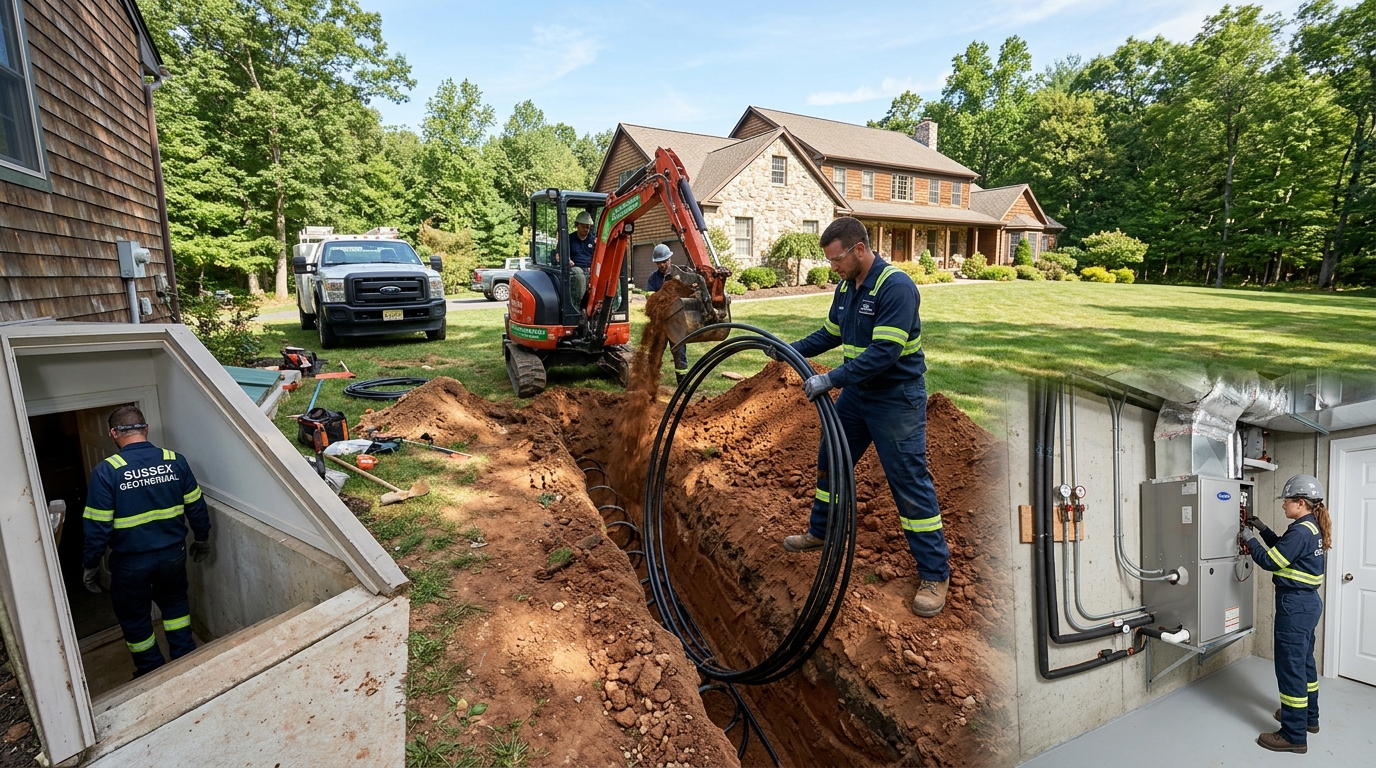
For new construction, the best approach is often a horizontal loop installed during excavation for the foundation. trenches four to six feet deep weave across the property, and the loop pipes are laid before backfilling. Retrofit installations on existing homes usually rely on vertical boreholes drilled by a local well driller. Each borehole accommodates a U-shaped loop of high-density polyethylene pipe that will outlast most mortgages.
Once the loop is in place, the indoor heat pump unit connects to your existing ductwork or a new radiant distribution system. Most installations take two to five days inside the home, with an additional one to two days for loop field construction. Because Constant Air Service handles the full project—from load calculations and loop design to heat pump commissioning and seasonal maintenance—Sussex County homeowners avoid the coordination headaches of juggling multiple contractors.
Are there tax credits and rebates for geothermal in New Jersey?
Yes. The federal residential clean energy credit allows homeowners to deduct 30% of the total geothermal installation cost from their federal taxes through 2032. For a $30,000 system, that is a $9,000 tax credit. New Jersey’s Clean Energy Program offers additional performance-based incentives for geothermal heat pumps, and some local utility providers run rebate programs that stack with the federal credit.
Financing options also help bridge the upfront gap. Hearth lending partners, available through Constant Air Service, offer loans up to $100,000 with terms that let homeowners start saving immediately while spreading the installation cost over time. In many cases, the monthly loan payment is lower than the former heating-fuel bill, making the switch cash-flow positive from day one.
How long do geothermal systems last, and what maintenance do they need?
The indoor heat pump unit typically lasts 20–25 years—roughly double the lifespan of a conventional gas furnace or central AC condenser. The ground loop, which contains no combustion components and sits protected underground, is often warrantied for 50 years and can function even longer with minimal degradation.
Maintenance demands are modest. An annual inspection covers filter changes, refrigerant-pressure checks, loop-fluid testing, and electrical-component verification. There are no outdoor coils to clean, no burners to adjust, and no pilot lights to monitor. Because the compressor operates at lower pressures than conventional systems—thanks to the moderate ground temperatures—mechanical wear is reduced, which trims long-term repair costs.
Homeowners should still enroll in a preventive maintenance plan to preserve manufacturer warranties and catch small issues before they become expensive problems. Constant Air Service offers seasonal maintenance plans tailored to geothermal systems in Sussex County, with priority scheduling for plan members.
Should Sussex County homeowners choose geothermal or stick with conventional HVAC?
The decision hinges on how long you plan to stay in your home, your current fuel costs, and your property’s suitability for a loop field. If you expect to remain in your Sussex County home for more than seven years, geothermal usually wins on total cost of ownership. If you are planning to move within three years, the payback period may not align with your timeline, though a geothermal system can boost resale value and appeal to eco-conscious buyers.
Environmental impact is another factor. A typical four-ton geothermal system reduces household carbon emissions by roughly 3–6 metric tons per year compared to oil or propane heat—equivalent to taking one car off the road. For Sussex County homeowners who prioritize sustainability alongside comfort, that matters.
Noise is a secondary benefit that gets overlooked. Because the heat pump lives indoors and the ground loop is silent, you eliminate the drone of outdoor AC condensers and exhaust fans. That is a noticeable upgrade for homes with bedrooms near the exterior unit.
Why Local Expertise Matters for Geothermal Installation
Geothermal is not a plug-and-play technology. Loop sizing must account for Sussex County’s heating-degree days, soil thermal conductivity, and the home’s heat-loss profile. Oversize the loop, and you pay for unnecessary excavation. Undersize it, and the system struggles during the coldest weeks of January. The same precision applies to heat-pump selection: a unit matched to your ductwork capacity and insulation level runs efficiently, while an mismatched unit cycles on and off, wasting electricity and wearing out components prematurely.
Constant Air Service is one of the few Sussex County contractors with full geothermal installation, repair, and maintenance capabilities. We size systems specifically for northwest New Jersey’s higher-elevation climate, accounting for mountain drafts, older construction, and extended heating seasons. Our NJ HVACR license (#19HC00108700) and 25 years of local experience mean we know the soil conditions, permitting requirements, and utility-rebate paperwork that out-of-area contractors overlook.
If you are considering geothermal for your Newton-area home, start with a free in-home estimate. We will evaluate your property, run a full load calculation, and present loop options that match your budget and your land. Call us at (973) 948-0680 or request a free quote online to get started.
Frequently Asked Questions About Geothermal HVAC
How much does geothermal HVAC cost to install in New Jersey?A typical residential installation ranges from $15,000 to $40,000 before the 30% federal tax credit and any state rebates. After incentives, the net cost often sits within $5,000–$10,000 of a high-efficiency gas system replacement.
Can a geothermal system heat and cool my entire house?Yes. A properly sized geothermal heat pump can deliver 100% of a home’s heating and cooling load, plus optional domestic hot water through a desuperheater attachment.
Does geothermal work in existing homes, or is it only for new construction?Geothermal retrofits are absolutely possible. Existing ductwork or hydronic systems can usually be reused, and vertical boreholes minimize disruption to established landscaping.
How quiet is a geothermal heat pump compared to conventional AC?Very quiet. Because there is no outdoor condenser fan or compressor, the only sound comes from the indoor unit’s blower and circulation pumps—roughly equivalent to a refrigerator hum.
Will a geothermal system increase my home’s value?Research from the Department of Energy and multiple housing studies indicates that homes with geothermal systems command a resale premium and sell faster in markets where energy efficiency is prized.
What happens if the ground loop leaks?Modern closed-loop systems use heat-fused polyethylene pipe with a 50-year warranty. Leaks are rare, but if one occurs, a pressure test isolates the issue and the affected section is repaired without excavating the entire field.
Ready for year-round comfort and real energy savings?Geothermal HVAC delivers steady temperatures, lower utility bills, and decades of reliable performance—but only when it is sized and installed by technicians who understand your local climate. Constant Air Service brings 25 years of Sussex County experience to every geothermal project, from Newton and Sparta to Branchville and Sandyston. Call (973) 948-0680 today for a free estimate, or schedule your consultation online and find out if geothermal is the right fit for your home.